
What Is Taiwan's Han Kuang Exercise?


For a few unusual minutes, the streets of Taiwan can suddenly fall silent.
Cars disappear from busy intersections. Pedestrians move indoors. Shops remain where they always are, traffic lights continue changing from red to green—but almost no one is there to cross the street.
It can feel strangely like a scene from a movie. But this isn't a movie.
It's part of Han Kuang, Taiwan's largest annual military exercise and a nationwide effort to prepare for emergencies.
What Does “Han Kuang” Mean?
“Han Kuang” is generally rendered in English as the name of the exercise rather than translated literally, while *yanxi* means “exercise” or “drill.”
The exercise began in 1984 and has since become the most important large-scale annual training event for Taiwan's armed forces.

Every year, the scenarios and training priorities are adjusted according to changes in military technology and the security environment.
What began more than four decades ago therefore looks very different today.
It Isn't Just One Exercise
The "Han Kuang" exercises are actually conducted in multiple phases.
In April 2026, the "Han Kuang 42" computer-aided command post exercise was held, lasting 14 days and 13 nights.
Military commanders and staff practiced a series of simulated scenarios, with the content gradually transitioning from gray zone pressure to high-intensity conflict.
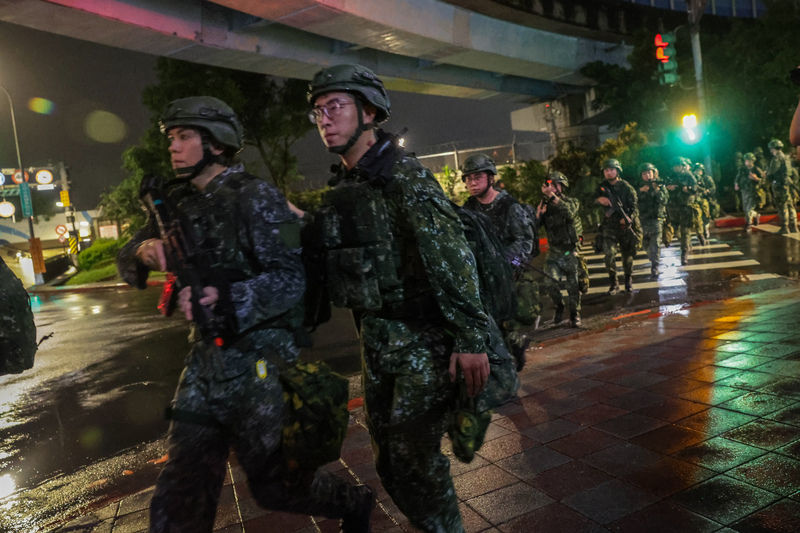
The second phase of the exercise was held from August 5th to 14th, with various units conducting 10 days and 9 nights of field training. In this phase, the openness of the exercise was significantly increased. This year's exercise focused on "deep and sustained operations," combined with the first-ever "urban resilient air defense exercise" and large-scale operational network de-speeding drills. Moreover, there was no script, and for the first time, two brigades were mobilized in both the north and south.
Training Around the Clock
Modern conflicts don't stop at sunset, Neither does Han Kuang.
The extended exercise period is designed to test whether military units can continue operating under fatigue and pressure rather than simply perform a carefully rehearsed demonstration for several hours.
Units have to move, communicate, resupply and respond to changing situations during both daytime and nighttime operations.
The idea is simple: A real emergency wouldn't follow a convenient schedule.
From Gray-Zone Pressure to Full Conflict

One important feature of recent Han Kuang exercises is that the scenario doesn't necessarily begin with a sudden large-scale attack.
Instead, training may begin with gray-zone activities—pressure and military actions that remain below the threshold of open warfare, The scenario can then gradually escalate.
Taiwan's Ministry of National Defense says the 2026 command-post exercise included phases covering situation response, force preservation, counter-landing operations, coastal defense, defense in depth and sustained operations.
That reflects a changing understanding of modern conflict: A crisis may develop gradually rather than begin with a single dramatic moment.
Drones Have Changed the Battlefield
Another major focus in 2026 was something that has transformed warfare around the world:
**drones**
Taiwan incorporated both drone and counter-drone operations into Han Kuang 42. Training included using drones for battlefield reconnaissance and target acquisition, while also practicing ways to detect and counter hostile unmanned aircraft.
It's a striking example of how quickly military technology has changed, Forty years ago, Han Kuang focused largely on conventional aircraft, ships, tanks and artillery.

Today, relatively small unmanned aircraft can play an important role in finding targets, gathering information and supporting military operations.
Taiwan's New Tanks Join the Exercise
The appearance of new equipment is another reason Han Kuang attracts public attention.
Recent exercises have incorporated newly acquired weapons and systems as Taiwan modernizes its armed forces.
But the purpose isn't simply to display military hardware, The larger challenge is learning how different branches of the armed forces—Army, Navy and Air Force—can communicate and operate together.
What Do Ordinary People Experience?
For most people living in Taiwan, Han Kuang doesn't mean watching tanks or fighter jets.
The most noticeable part may instead be an **air-defense or urban-resilience drill**.
In 2026, urban-resilience air-defense exercises were conducted in different regions on August 7 and August 10–13 alongside the Han Kuang field exercise.
Each regional drill lasted about 30 minutes and included warning systems, evacuation and shelter procedures, traffic controls and disaster-response exercises.

When the traffic lights keep changing but the streets are empty, Han Kuang becomes more than a military exercise. For a brief moment, ordinary people get a glimpse of what emergency preparedness actually looks like.
More Than a Military Exercise
This is perhaps the biggest change in the way Taiwan thinks about preparedness, A major emergency wouldn't affect only the military.
Hospitals would still need to operate, Communications would need to continue, Local governments would need to respond to disasters.
Food, water and essential supplies would still have to reach communities, And ordinary people would need to know where to go and what to do.
That's why Taiwan has increasingly connected military exercises with broader civil-defense and urban-resilience training.
The goal isn't simply to test whether soldiers can fight, It's also to test whether society can continue functioning under extreme pressure.
Why Han Kuang Matters
To visitors, seeing military vehicles moving through Taiwan or hearing an air-raid warning during an exercise can feel unusual.
For Taiwan, however, Han Kuang is an annual attempt to answer difficult questions before a real emergency happens.
It's about how an island of more than 23 million people prepares to keep functioning when normal life is suddenly disrupted.


Comments