
The World of Interstellar — Could It Really Happen?


Imagine leaving Earth for just a few hours, You land on another planet, You walk across its surface, You complete your mission, Then you return to your spacecraft.
For you, only a few hours have passed, But for the person waiting aboard the ship, more than 20 years have gone by, It sounds impossible.
Yet one of the strangest ideas in Interstellar is also based on one of the best-tested theories in modern physics: Time does not pass at the same rate everywhere.

Christopher Nolan's Interstellar takes this real scientific principle and pushes it to an extraordinary extreme, The movie gives us a wormhole near Saturn, a gigantic black hole called Gargantua, planets where time behaves differently, a journey through an event horizon and, eventually, a mysterious five-dimensional structure where time itself seems almost like a physical landscape.
Some of it is real science, Some is theoretically possible, And some belongs firmly to science fiction.
So let's ask the question: Could Interstellar Really Happen?
Earth Is Dying
The story begins not among the stars, but on Earth, Humanity is facing an environmental catastrophe, Crops are failing, Dust storms sweep across farmland, Food is becoming increasingly difficult to produce.

Former NASA pilot Joseph Cooper, played by Matthew McConaughey, now lives as a farmer with his family, His daughter Murph begins noticing strange patterns in her bedroom, Books fall from shelves, Dust forms unusual lines on the floor.
She thinks there's a ghost, Cooper eventually realizes something else is happening, Gravity is sending a message.
The coordinates lead him to a secret NASA facility, And that's where he discovers humanity's extraordinary plan.
A Wormhole Has Appeared Near Saturn
NASA scientists reveal that a wormhole has mysteriously appeared near Saturn, A wormhole is essentially a hypothetical shortcut through spacetime.
Imagine the universe as a sheet of paper, Two points may be extremely far apart if you travel across the surface, But fold the paper until those two points touch--and suddenly the journey becomes much shorter, That's the basic idea behind a wormhole.
In Interstellar, the wormhole allows Cooper and the crew of the Endurance to cross an enormous cosmic distance and reach another galaxy.
But here's our first question:
Could a wormhole really exist?
Possibly—but we don't know.

Wormholes can appear as mathematical possibilities within general relativity, but no traversable wormhole has ever been observed. Keeping one open long enough for a spacecraft to pass through would appear to require exotic conditions such as negative energy, and physicists do not know whether a human-traversable wormhole is physically possible.
So we'll give this one: Theoretically Possible — But Highly Speculative, And then the Endurance reaches something even more extraordinary.
Meet Gargantua
On the other side of the wormhole is an enormous rotating black hole, Gargantua, And this is where Interstellar becomes scientifically fascinating, Black holes were not invented for science fiction, They are real astrophysical objects.
Their gravity is so intense that beyond a boundary called the event horizon, not even light can escape, But Gargantua doesn't look like the simple black circle many movies had traditionally shown, Its glowing disk seems to bend above and below the black hole.

Why? Gravity bends light.
The enormous gravity around the black hole distorts spacetime, allowing us to see light from parts of the accretion disk that would normally be hidden behind it.
For Interstellar, Kip Thorne supplied the physics equations used by the visual-effects team to calculate how light should travel through the curved spacetime surrounding Gargantua. Their work eventually contributed to scientific papers on black-hole visualization.
The filmmakers did make artistic compromises—for example, suppressing some realistic Doppler brightness and color effects because the scientifically fuller image would have been confusing to audiences.
Still: Gargantua's Appearance — Strongly Grounded in Real Physics, But looking realistic is one thing, The next part is much harder to believe.
One Hour = Seven Years
Cooper, Brand and Doyle travel down to Miller's Planet, It's an ocean world orbiting extremely close to Gargantua, Before they land, they're warned about the cost, For every hour they spend on Miller's Planet: Approximately seven years pass far away from Gargantua.
Think about that.
1 hour → 7 years
3 hours → 21 years
And that's essentially what happens, Their mission goes wrong, They encounter enormous waves, Their departure is delayed, When Cooper and Brand finally return to the Endurance, astronaut Romilly is waiting for them.

For Cooper and Brand, only hours have passed, For Romilly—23 years.
And this leads to the biggest question people ask after watching Interstellar:
Can Gravity Really Slow Down Time?
Yes.
Absolutely, This part is real physics, According to Einstein's general theory of relativity, gravity affects the passage of time, The stronger the gravitational field, the more slowly time passes relative to regions experiencing weaker gravity.
This is called: Gravitational Time Dilation.
It isn't merely an idea created for movies, Time dilation is a genuine consequence of relativity, The difficult part isn't whether the effect exists, The difficult part is whether it could become as extreme as:
1 hour = 7 years.
Could Miller's Planet Really Have That Much Time Dilation?
This is where things become extreme, For Miller's Planet to experience such enormous time dilation while remaining in orbit, Gargantua needs to be a rapidly spinning supermassive black hole.
A spinning black hole drags spacetime around with it—an effect known as frame dragging, That rotation allows stable orbits much closer to the event horizon than would be possible around a non-rotating black hole.
Kip Thorne calculated that the movie's seven-years-per-hour ratio could be achieved without violating the laws of physics if Gargantua spins extraordinarily fast. He also acknowledged that the required spin is far beyond what would seem astrophysically reasonable—but it is not strictly forbidden by known physics.
So: One Hour = Seven Years — Physically Possible Under Extremely Special Conditions
This isn't simply Hollywood making up a number, Nolan wanted seven years, Thorne worked out what kind of black hole would be required to make it possible.
And the answer was: A truly ridiculous black hole.
What About Those Giant Waves?

Miller's Planet gives us another unforgettable image, At first, Cooper looks toward what appears to be a mountain range, Then someone realizes: Those aren't mountains, They're waves.
Enormous walls of water race toward the crew, Could Gargantua's gravity create enormous tides? Certainly.
A massive gravitational source can produce powerful tidal forces, But the exact enormous, regularly spaced waves depicted in the movie are considerably more complicated to justify.
Thorne explored a physical interpretation for them, but this is one of the places where the movie's storytelling pushes beyond straightforward established science.
So we'll call this: Inspired by Physics — Heavily Dramatized, But the emotional consequence of Miller's Planet is completely different.
Cooper Watches His Children Grow Up in Minutes
When Cooper returns to the Endurance, he finds years of video messages waiting for him, His son grows older, His family changes, People die.

His children build lives without him, And Cooper watches decades of their lives pass across a screen in minutes.
This is where Interstellar does something brilliant, It takes an abstract physics concept—time dilation and turns it into something emotionally understandable.
The equation isn't the tragedy, The tragedy is: Cooper lost years with his children, while barely aging himself, Relativity becomes personal.
And this idea follows him all the way to Gargantua.
What Happens If You Fall Into a Black Hole?
Near the end of the movie, Cooper makes a desperate decision, He separates from the spacecraft and falls toward Gargantua, Normally, this sounds like a very efficient way to die.
For many black holes, enormous differences in gravity between one part of your body and another could stretch you apart—a process famously nicknamed: Spaghettification.
But Gargantua is supermassive, That's important, For a sufficiently massive black hole, the tidal forces at the event horizon can be much gentler than those around a smaller black hole.
In principle, an astronaut might cross the event horizon of a sufficiently massive black hole without being instantly torn apart at that exact moment, That doesn't mean the journey ends well.
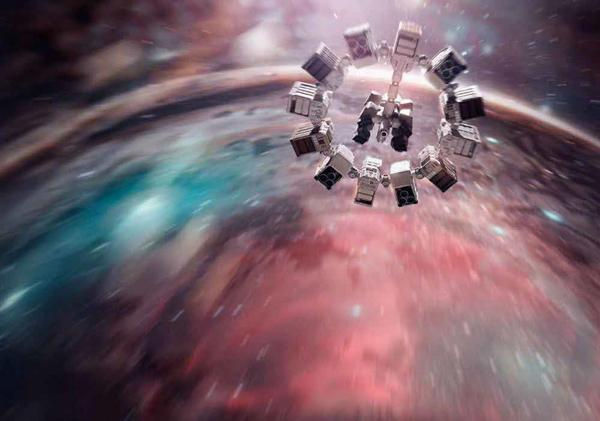
Once inside, escaping back through the event horizon isn't part of ordinary established black-hole physics, Eventually, things become much worse.
So:
✔ Crossing a Supermassive Black Hole's Horizon Alive — Conceivable
✘ Coming Back Out Normally — Not According to Known Physics
But Cooper doesn't experience a normal black-hole interior, He finds something else.
The Tesseract
Cooper suddenly enters a strange structure, He can see countless versions of Murph's bedroom, Not just in different places—but at different times.
He realizes something extraordinary, He was Murph's “Ghost”, The books falling from the shelf, The strange patterns...The gravitational messages.
They were Cooper communicating with his daughter across time, The movie suggests that advanced future humans—or higher-dimensional beings connected to humanity—created this structure so Cooper could interact with time in a way ordinary humans cannot.

Now we have crossed an important boundary.
The Tesseract — Science Fiction
Higher dimensions do appear in theoretical physics, and Interstellar drew inspiration from speculative ideas involving extra dimensions. But there is no established scientific mechanism by which a human could enter a black hole and access different moments in another person's bedroom as physical locations. Thorne himself described this part of the film's framework as belonging to much more speculative physics.
And yet, as science fiction, it's a beautiful idea, Because it changes the way we understand the beginning of the movie.
Cooper Was the Ghost All Along
Murph thought there was a ghost in her room, Cooper initially dismissed it, But the “ghost” was Cooper himself, Not from the past, From his future.
Inside the tesseract, he uses gravity to communicate information across time, Eventually, he transmits crucial quantum data through the second hand of Murph's watch, Murph understands the message.

The information helps humanity solve the gravitational problem necessary to escape Earth, The father who left his daughter—ultimately helps save her future.
But this creates another interesting logical problem.
Who Started the Loop?
Think about what happens, The gravitational message leads Cooper to NASA, NASA sends Cooper through the wormhole, Cooper enters Gargantua, Inside Gargantua, Cooper sends the gravitational message—that originally led himself to NASA.
So which happened first? This is known as a causal loop or bootstrap-style paradox.
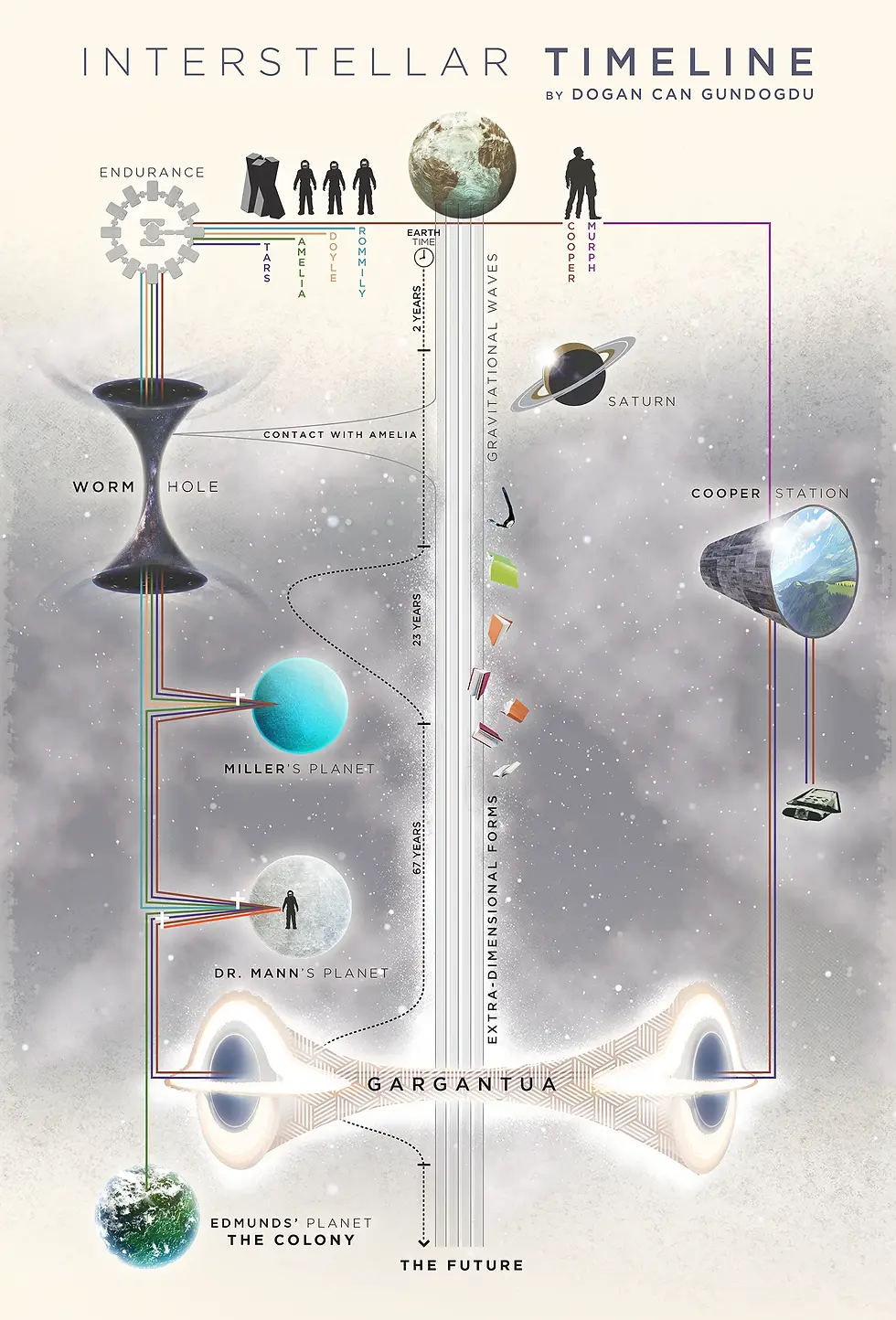
Event A causes Event B, But Event B also causes Event A.
There is no obvious beginning, The movie doesn't solve this problem in the ordinary sense, It embraces it, Time isn't necessarily being presented as a simple straight line.
And that's where Interstellar moves away from conventional space adventure into something much stranger.
And What About “Love Transcending Dimensions”?
This is one of the most debated parts of the movie, Brand argues that love may have significance beyond the dimensions humans normally experience.
Taken literally as physics: Love Is Not a Known Physical Force, We have gravity, Electromagnetism, Strong nuclear interaction, Weak nuclear interaction, Love isn't number five.

But I don't think the movie is really trying to add “love” to a physics textbook, It's using love as a narrative idea, Gravity allows Cooper to send the information.
But his relationship with Murph tells him where to send it, Physics provides the mechanism, Human connection provides the direction, That's a very different claim.
So How Much of Interstellar Is Actually Real?
Here's the easiest way to separate it:
Idea | Scientific Status |
Black holes exist | 🟢 Real |
Gravity bends light | 🟢 Real |
Gravity slows time | 🟢 Real |
Rotating black holes | 🟢 Real physics |
Gargantua's visual appearance | 🟢 Strongly physics-based |
Extreme Miller's Planet time dilation | 🟡 Possible, but requires extreme conditions |
Planets near a supermassive black hole | 🟡 Conceivable, with major complications |
Giant Miller waves | 🟠 Physics-inspired / dramatized |
Traversable wormhole | 🟠 Highly speculative |
Human-made stable wormhole | 🔴 Beyond current science |
Tesseract inside a black hole | 🔴 Science fiction |
Communicating with your daughter through her bookshelf across time | 🔴 Definitely don't try this at home |
The fascinating thing is that Interstellar doesn't hide the boundaries between these categories, It deliberately begins with physics we understand—then gradually travels toward physics we don't.
That was part of Kip Thorne's approach to the project: begin with established science, move through informed speculation, and clearly recognize when the story reaches beyond what science can currently justify.
Interstellar's Black Hole Came Before We Photographed One
There's another wonderful piece of history here, Interstellar was released in 2014, At that time, humanity had never directly imaged a black hole.
Five years later, in 2019, the Event Horizon Telescope collaboration released humanity's first image of a black hole's shadow.
The two images shouldn't be treated as identical—they represent different objects and observational circumstances—but the timing made Gargantua's scientifically grounded visualization particularly memorable.
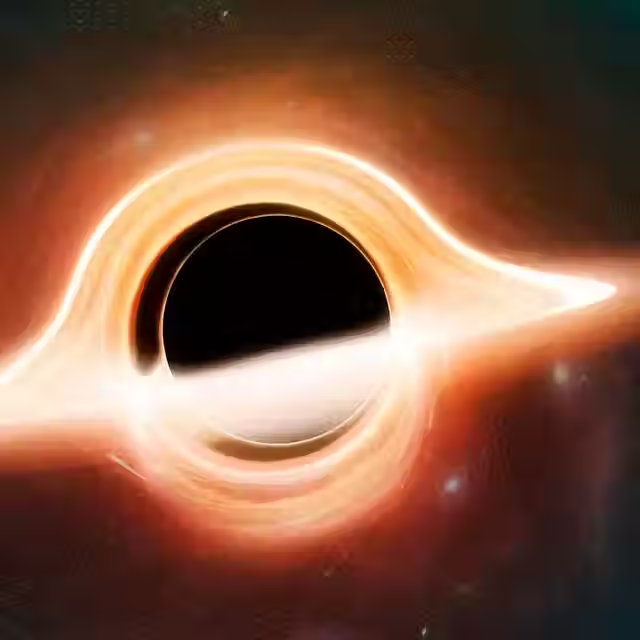
The techniques developed for the movie's black-hole rendering were sophisticated enough that members of the team published work about visualizing curved spacetime, and the renderer continued to have scientific as well as visual-effects applications.
So Interstellar didn't “predict” the first black-hole photograph, But it did something arguably more interesting: It turned Einstein's equations into cinema.
Could Interstellar Really Happen?
Not exactly, We can't build a spacecraft tomorrow, fly to Saturn and expect to find a convenient wormhole waiting for us, We don't know how to build traversable wormholes.
We don't know how to enter a black hole and reach a five-dimensional library, And we certainly don't know how to send messages into the past through someone's bookshelf.
But that's not the surprising part, The surprising part is how much of the movie isn't simply fantasy, Black holes are real, Spacetime really bends, Gravity really affects time.
A person traveling through extreme gravitational environments really could experience time differently from someone far away.
And the universe really does contain places where our everyday understanding of space and time stops being useful, That's what makes Interstellar different from many science-fiction movies, It doesn't begin by asking us to believe in magic.

It begins with Einstein, Then it asks: How far can we follow the physics before science becomes imagination?
The Real Power of Interstellar
Perhaps the most extraordinary thing about Interstellar isn't Gargantua, It isn't the wormhole, It isn't Miller's Planet.
It's what the movie does with time, For physicists, time dilation can be expressed mathematically.

For Cooper, it means missing his children's lives, One hour becomes seven years, A short mission becomes decades, A father leaves his daughter as a child and returns to find her near the end of her life.
The science makes the situation possible, But the human cost makes us understand it, And that's why, more than a decade after Interstellar first appeared, people are still asking the same question:
Could this really happen? The answer might be the most Interstellar answer possible:
Some of it already does. Some of it might. And some of it remains beyond everything we currently know.


Comments